PROVEAiBLE turns your intake into a conversation that listens to every person in their own language, flags who’s eligible and who’s urgent, surfaces safeguarding concerns, and redacts personal details before the case-analysis model sees them — handing your caseworker a structured case file, 24/7, in 60+ languages.
Request a demoThe finished case file reaches your caseworker, the person served keeps a plain-language copy, and every source document arrives redacted. Open any of them and read it.
They’re already reaching out — but most people with a legal problem never get any help. Worldwide, an estimated 5.1 billion have an unmet justice need.
World Justice Project — estimated 5 billion with unmet justice needs globallyLow-income Americans receive no, or not enough, legal help for the large majority of their civil legal problems. The need is met a fraction of the time.
US Legal Services Corporation — Justice Gap researchCommunity legal centres turn away roughly 368,000 people a year — not for lack of a cause, but for lack of capacity to reach them all.
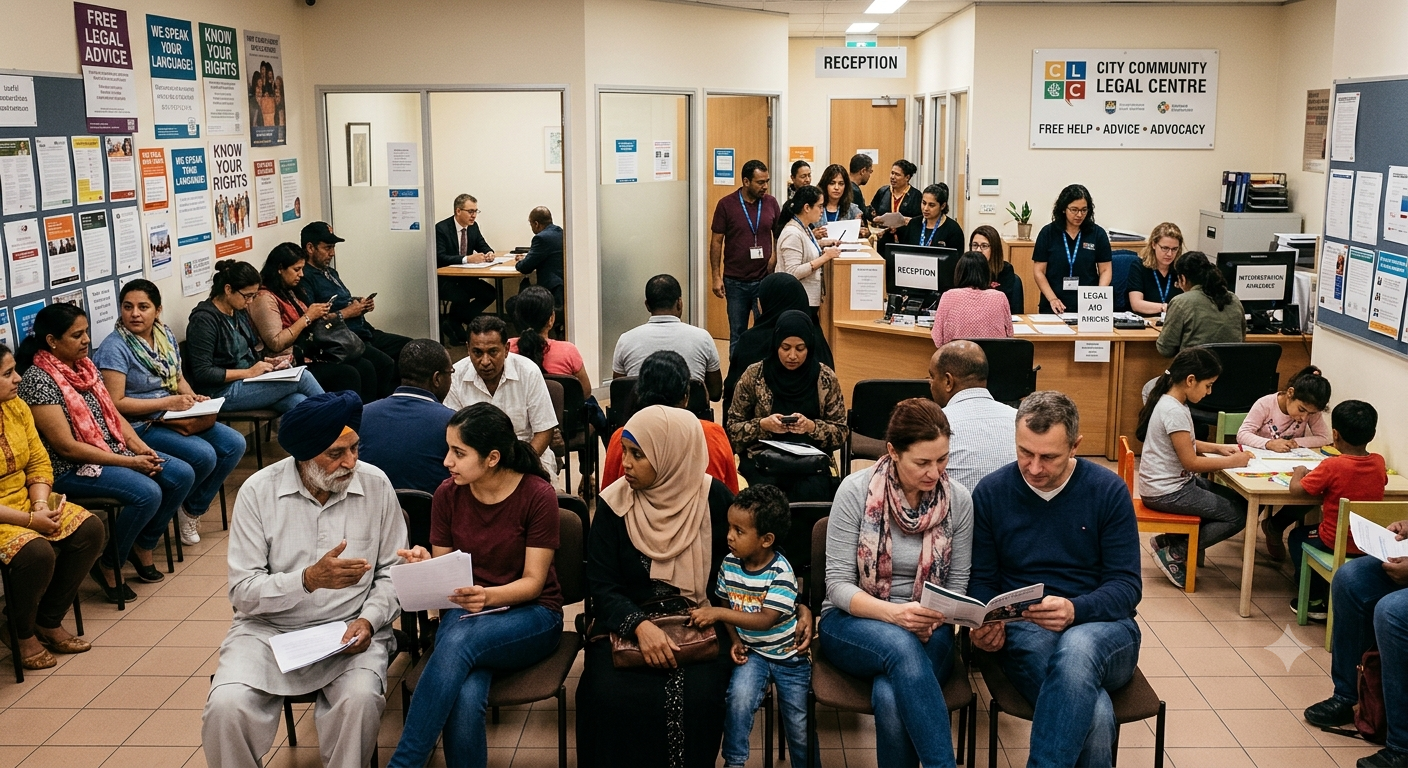
Community Legal Centres Australia — 2022–23The enquiries arrive after hours, in languages nobody at the desk speaks, faster than a small team can screen them. The people behind them go without.
Every enquiry — 24/7, in 60+ languages — listened to, screened for eligibility and urgency, redacted and filed to your caseworker. Fewer people are turned away because no one was at the desk.
of low-income Americans’ civil legal problems get no, or not enough, legal help
US Legal Services Corporation — Justice Gap researchpeople turned away by Australian community legal centres in a single year
Community Legal Centres Australia — 2022–23Most people who need legal help never get it — not because the help doesn’t exist, but because they can’t reach it in time, in their language, at the hour they’re free. Intake that never closes is how a stretched service reaches more of them.
World Justice Project — estimated 5 billion with unmet justice needsNo forms for the person, no re-keying for your team, no data-entry appointment. Just a case someone has already read.
They tell their story in their own words — any hour, any device, in 60+ languages. Gentle, no forms, no jargon.
Every fact becomes structured data as they speak, and the enquiry is screened for eligibility and urgency — with any safeguarding concern flagged, so no one waits in a blind queue.
Personal identifiers are replaced with role tags before the case-analysis model sees them, and the person reviews exactly what's hidden before it's sent.
A structured case file reaches your caseworker; the person keeps a plain-language copy. Nothing kept long-term.
No portal to log into, no new tool for your team to learn. The prepared file reaches your caseworker, and they open the first appointment already knowing the story.
Documents, dates, the people involved and any safeguarding concern — sorted before they sit down. Your caseworker spends the time on the person, not the intake form.
No portal, no training. Every completed intake arrives screened for eligibility and priority in the inbox your caseworkers already use — day, night, weekend, any language. Fictional cases shown.
The people your centre serves are often frightened, exhausted, and telling a hard story to a stranger. The intake is built to meet them gently — and more of them finish it, so more of the people you want to help actually reach you.
Plain questions, one at a time. No jargon, no blank fields to stare at. Documents are optional — talking is enough.
Telling the worst moments of your life is exhausting. They can stop, get a private link, and pick up where they left off.
The intake captures every statement the person makes, then shows them a plain-language summary of it — which they read, edit if anything’s wrong, and confirm before it’s sent to your centre. What your caseworker opens is confirmed by the client, not an AI’s best guess.
Six capabilities do the work of a first intake appointment. Open any one for the full walkthrough.
Someone tells their story in their first language, at any hour; your caseworker opens a structured English file — eligibility and urgency already screened, references stripped first.
The person chats in their own language; the finished case file lands in yours — no interpreter needed at first contact.
Multilingual intakeAnswered 24/7 — on your site, a shared link, a QR code in the shopfront or your email signature. Most people reach out after work.
After-hours & multi-channelIdentifiers become role tags before the case-analysis model builds the file; the person reviews what’s hidden first.
Redaction & privacyRuns on your centre’s own AI account — our price is our fee; AI usage is about €1 an intake, billed by your provider, never marked up.
Bring your own key The case fileSummary, key facts, chronology, the people involved, documents on file and what’s still missing — with safeguarding concerns and gaps surfaced for the first appointment.
See what you openTwo things a caseworker always has to settle first — whether you can act, and where a matter goes if you can’t.
Current-lawyer and opposing-party details are captured up front for your conflict check — never sent to the AI.
Can’t take a matter? The structured file goes out with the referral — the next centre doesn’t start from scratch.
People should feel like they’re talking to your service — because they are. Pick a look that fits, or tell us your brand and we build it. Either way it’s live before you launch.
A branded widget is the easy part. The value is the configuration — and for founding centres we do it with you, by hand. Not a template dropped in your lap; an intake tuned to the people you actually serve, built before a single person sees it.
Your widget converses in 60+ languages; its interface is localised in 13.
We configure your matter types, redaction profiles and catchment, then hand it over — ready for your team to test within 2–5 days of setup.
We configure matter types, redaction & catchment
You test it on your own intake
Ready within 2–5 days of setup
The questions, the eligibility criteria, the redaction profile and the case file adapt to the matter — tuned to any area your service runs: housing, immigration & asylum, family, employment, domestic violence, discrimination and debt. A few examples:
Eviction, disrepair and homelessness — captured while it’s urgent, screened for eligibility, and the hearing date that can’t be missed flagged to the top of the file.
Every area is configured with you at setup.The person’s story in their own language becomes a structured English case file — the documents they hold and the deadline that matters, surfaced before the first appointment.
See the immigration walkthroughUnpaid wages, dismissal, underpayment — the fiddly facts caseworkers usually chase arrive structured: dates, amounts, employers, ready to act on.
Every area is configured with you at setup.Sensitive matters handled with care — gentle questioning, the person controls what they share and can stop any time, and details are redacted before your team ever sees them.
Every area is configured with you at setup.These are examples. We configure the questions, eligibility criteria, redaction profile and case file for whatever areas your centre serves — during setup.
Every area is configured with you at setup.One intake front door, tuned to the way each service works — the same eligibility screening, safeguarding flags and redaction, whoever you serve.
Reach more of the people who walk through your door. Every enquiry is screened for eligibility and urgency, in 60+ languages, on the budget you already have.
A front door that never closes, so a stretched legal aid service turns fewer people away — matters arrive redacted, structured and means-tested against the criteria you set.
Supervised students focus on the law, not the intake admin. Redacted case files land before each supervision, intake runs right through term, and your eligibility and safeguarding rules are configured the same way — a live privacy lesson built in.
In May 2025, a US federal court ordered OpenAI to preserve every ChatGPT conversation — including the ones users had deleted. By late 2025 it was ordered to hand 20 million of those logs to opposing lawyers. U.S. District Court, S.D.N.Y. — New York Times v. OpenAI
That’s the risk of letting someone pour their situation into a consumer chatbot: the data is retained, and it can be subpoenaed. PROVEAiBLE is built the opposite way — the AI never sees who the person is, and case data is deleted the moment it’s delivered to your caseworker.
The identity is stripped before the reasoning starts, and the person stays in control of their own data.
Hi, my name is Amara Okonkwo. I live at 22 Beckett House, my date of birth is 12 March 1991, and you can reach me on 07700 900318. My landlord, David Reyes, is trying to evict us before the hearing.
The case-analysis model only ever sees the role tags — and the person reviews exactly what's hidden before anything is sent.
Completed intakes are deleted on delivery; incomplete sessions are purged within 90 days.
See the full architecture — jurisdictions, the DPA and every sub-processor — on our compliance page →
For organisations serving domestic-violence survivors and other clients at risk, we configure additional safety measures with you during setup.
One tap clears the session and leaves the page instantly.
The intake can prompt private mode for clients in unsafe situations.
Nothing stored that could reveal the visit.
None passed to or from your site.
Quick-exit shown top-right. Community-branded, fictional.
Available on request and configured to your safeguarding policy — not on by default. Tell us your requirements and we build to them.
Your cost per person drops as you grow. €29 / month minimum.
Enquiries your own eligibility criteria filter out never count — if someone falls outside the scope or means test you set, the intake is declined automatically and never billed. You pay only for completed, qualifying intakes.
*Bring your own AI key — the price above is our fee; AI usage is billed by your own provider (about €1 an intake), never through us. If cost is genuinely a barrier for your service, tell us.
The AI runs on your centre’s own key (BYOK), so AI usage is billed by your provider — approximately US$0.50–$1 per completed intake, depending on conversation length and how many documents it reads. Priced in USD by the AI provider (AI APIs bill in USD) and never marked up by us; a chat-only intake costs less than one with several documents.
Every completed intake — the case file, the plain-language summary and the redacted documents — lands in your inbox, ready to drop into your case-management system. No portal, no training, nothing to host.
No. Someone can complete the whole intake just by talking — which matters for people who are frightened, displaced, or don't have their paperwork. If they do have documents, they can add them and the details are pulled into the file; if they don't, the conversation is enough.
Two things, kept separate. Your subscription to us — €29/month minimum, then you only pay for the intakes we actually complete: €2 each for the first 100 in a month, €1.50 for 101–400, and €1 above that. Enquiries that fall outside your eligibility criteria are free, and there's no per-seat licence. The build is hands-on: we configure your eligibility, safeguarding triggers, redaction profiles and catchment with you before it goes live. And AI usage is separate, billed by your own provider (Claude or ChatGPT) directly — we never mark it up. To give you a real number: the asylum intake in the demo above — three documents read and redacted, a full case file and a summary produced — cost about €1. If cost is genuinely a barrier for your service, tell us.
Let's be straight about cost. The subscription starts at just €29/month, and beyond that you only pay for completed intakes — €1 to €2 each depending on volume, and nothing for the enquiries your criteria filter out. The ongoing AI usage is deliberately small too — it runs on your own AI account at about €1 an intake, billed by your provider directly. There's nothing to host, no system to maintain, and no per-seat licence. And if cost is genuinely a barrier for your service, tell us — we'd rather find a way than turn away a centre that needs this.
Sensitive matters are handled gently — the person controls what they share and can stop at any time, and details are redacted before your team sees them. Your safeguarding triggers are configured with you before it goes live, so risk and vulnerability are flagged to the top of the file. They're not on by default.
60+ languages. The person intakes in their own language and your caseworker reads the file in English — so you can take someone in without an interpreter at first contact. It runs on Claude and ChatGPT models.
No — deliberately. It gathers and structures the facts so your caseworker opens a prepared file instead of a blank page. It never advises, never opines, and never replaces your team's judgement. The advice is always yours.
I'll send you a private demo tuned to the matters your centre handles — housing, immigration, employment, whatever your community brings. Free, no card, no call.
— Andrew, PROVEAiBLE
